Cloud and on-premise ERP each offer distinct advantages. Here's how to weigh cost, control, scalability, and security to choose the deployment model that fits your business.
What is Cloud ERP?
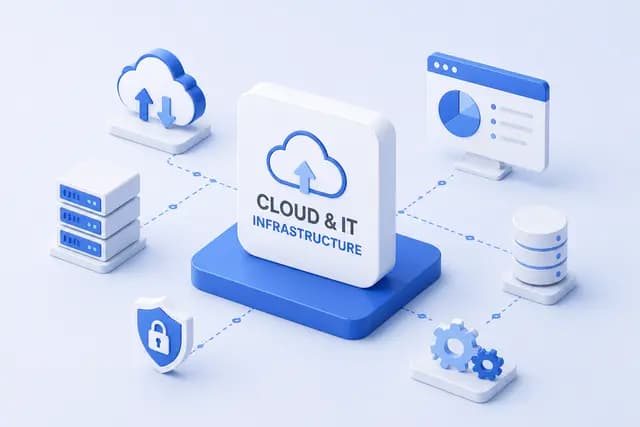
Cloud ERP is hosted on secure cloud infrastructure and accessed through the internet. Instead of maintaining servers and infrastructure in-house, businesses use ERP software that is managed by the cloud provider or implementation partner. This model allows employees to securely access business data from anywhere using desktops, laptops, tablets, or mobile devices.
Benefits of Cloud ERP
Lower Initial Investment — eliminates the need for expensive server infrastructure and hardware, reducing upfront costs.
Remote Accessibility — employees can securely access the system from any location, enabling remote work and mobile workforce management.
Automatic Updates — software updates, security patches, and new features are deployed regularly.
Scalability — additional users, storage, and resources can be added quickly without major infrastructure changes.
Business Continuity — built-in backup, disaster recovery, and high availability features minimize downtime and protect business data.
What is On-Premise ERP?
On-Premise ERP is installed and managed on servers located within the organization's own infrastructure. The business has complete ownership and control over its hardware, software, and data. This deployment model is often preferred by organizations with strict regulatory, security, or operational requirements.
Benefits of On-Premise ERP
Complete Control — organizations maintain full control over system configuration, infrastructure, data storage, and security policies.
Customization — businesses with highly specialized processes can implement extensive customizations.
Internal Data Management — sensitive business information remains within the organization's own infrastructure, which may be important for compliance or governance.
Long-Term Investment — for organizations with stable infrastructure and dedicated IT teams, on-premise ERP can provide predictable long-term ownership.
Cloud ERP vs On-Premise ERP at a Glance
Initial cost: lower for Cloud, higher for On-Premise
Infrastructure: provider-managed for Cloud, internally managed for On-Premise
Accessibility: available anywhere with internet for Cloud, internal network or VPN for On-Premise
Software updates: automatic for Cloud, manual for On-Premise
Scalability: easy for Cloud, requires hardware upgrades for On-Premise
Maintenance: provider-managed for Cloud, internal IT team for On-Premise
Disaster recovery: built-in for Cloud, organization-managed for On-Premise
Deployment time: faster for Cloud, longer for On-Premise
Which Option is Right for Your Business?
Cloud ERP is generally ideal for businesses that want faster deployment, reduced IT management, flexible scalability, and remote accessibility. It enables organizations to focus on business growth while leaving infrastructure management to trusted technology partners.
On-Premise ERP may be the better choice for organizations that require complete infrastructure control, have strict compliance requirements, or already maintain a dedicated IT environment capable of managing enterprise systems.
The right decision ultimately depends on your organization's operational needs, security policies, available resources, and long-term technology strategy.
How ALLE TECH Can Help
Selecting an ERP deployment model is more than a technical decision — it's a strategic business decision. At ALLE TECH, we help organizations evaluate their business requirements, infrastructure, growth plans, and security considerations before recommending the most suitable ERP deployment approach.
Whether you're implementing Odoo ERP in the cloud, deploying it on-premise, or planning a hybrid strategy, our consultants provide end-to-end support, including planning, implementation, customization, migration, integration, training, and ongoing managed services.
Conclusion
There is no one-size-fits-all approach to ERP deployment. Both Cloud ERP and On-Premise ERP offer significant advantages when aligned with the right business strategy.
By understanding the strengths of each model and partnering with experienced ERP consultants, organizations can build a technology foundation that supports operational efficiency, business agility, and sustainable long-term growth.